Send short faxes together.
Recipient-approved batching shares one SIP call, with a wait limit, page cap, separators and a result for each document. Include the separators when pricing the batch.

For the administrator responsible for the fax path.
Keep inbound and outbound independent. Route by destination history and actual billing rules. Trace the media path. Deliver approved case updates without retransmitting the whole file.
The infrastructure you already administer
One organization can receive over SIP, send through a cloud account, and use the trunk as an additional outbound route.
Keep those choices independent. Use destination preferences, provider capability checks and mailbox permissions. Every accepted fax keeps its attempt history and provider identity, including when a confirmed failure moves it to another route.
Connect a carrier or an Avaya IP Office or Aura phone system. Diagnose registration, NAT, T.38 negotiation and G.711 separately. A successful SIP sign-in is only the start of the fax path.
Inspect the trunk configuration →Multi-trunk composition can be scoped around your sites, vendors, inbound and outbound paths, and authorization rules. The standard built-in Asterisk connection and trunk are configured once per installation.
Where the invoice actually changes
A faster call, a smaller PDF and a lower rate are different improvements. They do not always reduce the bill.
Recipient-approved batching shares one SIP call, with a wait limit, page cap, separators and a result for each document. Include the separators when pricing the batch.
Reference accepted documents and send new or revised originals where the recipient agrees. Preview exactly what the packet includes and leaves out.
Verified Faxbot partners receive the encrypted original and return a signed receipt. Other destinations retain ordinary fax delivery.
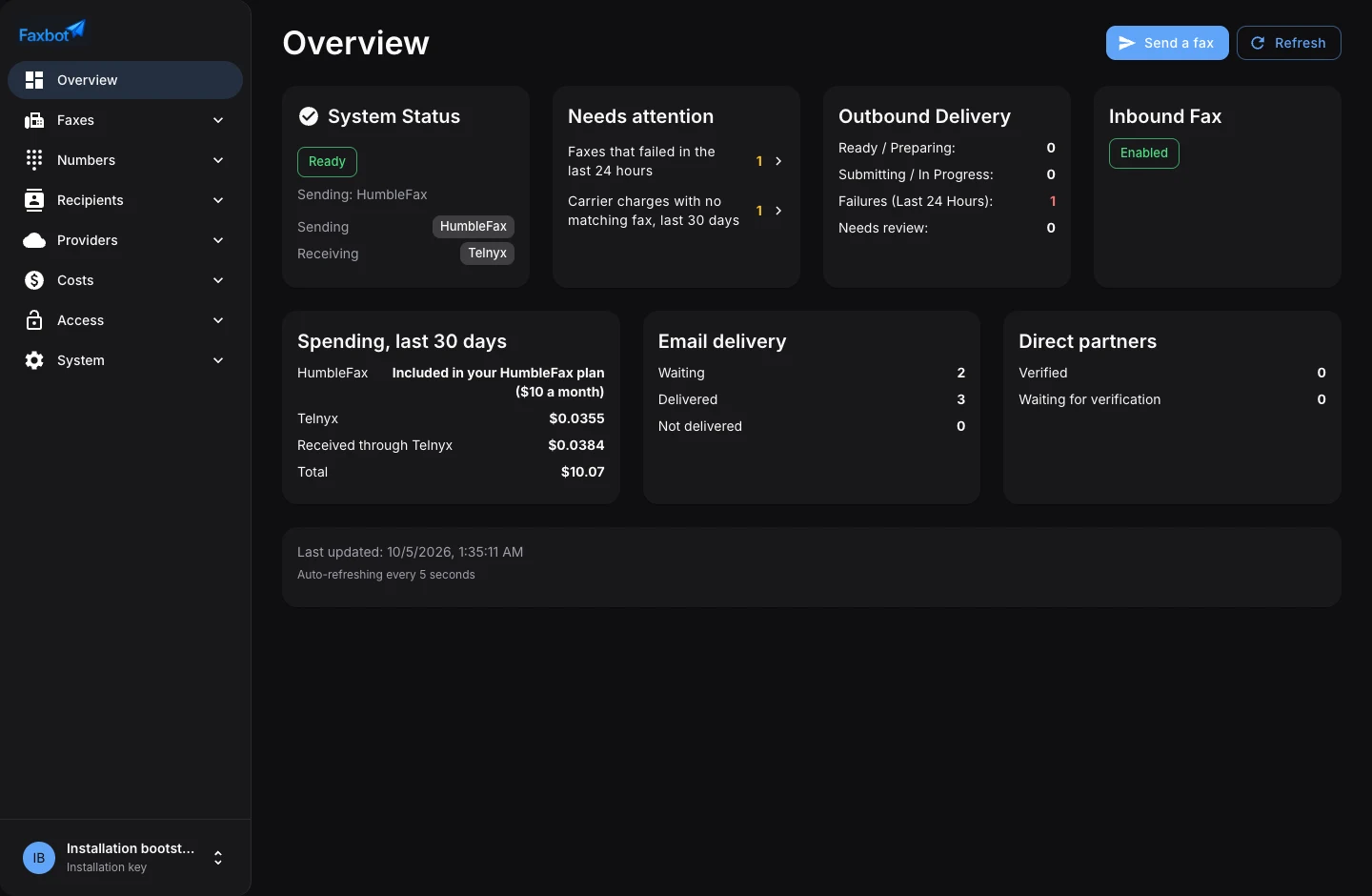
Count charged failures, monthly plans and unmatched carrier calls. Keep estimates separate from reported charges. A missing charge remains unknown.
Read the routing, batching and billing behavior →Automatically signed in for read-only inspection of real routes, carrier costs, fax metadata and call diagnostics.
Live acceptance installation. Read-only access opens automatically. Document downloads, paid sends and administrative changes are unavailable. The live connection depends on the demo host being online.
Inspect actual carrier charges, the route used by each attempt and documents recovered after acquisition failed.

Captured from the real installation. Carrier charges and plan fees shown are its records; they are not a customer savings forecast.
The details that decide whether it works
Open a mechanism for the implementation, prerequisites and limits. Explore available behavior and capabilities tailored to your setup.
Tailored capabilities are scoped and developed for your installation. They are not included in the standard release.
Your receiving contract should not decide how every outbound fax travels.
Keep inbound and outbound providers independent. Add authorized outbound routes, set a preference for a destination, and retain the provider and configuration bound to every attempt.
Cloud adapters, HTTP provider manifests, Asterisk and FreeSWITCH have different capabilities. An extra route is not another instance of the built-in SIP trunk.
Inspect the documented behavior →A cheap route that repeatedly fails adds attempts, charges and delay.
Rank routes using known rates and recent delivery history for the destination. Record why a route was selected and use confirmed failure to move to another route.
Current selection uses a reliability threshold. Optimization by actual cost per delivered fax can be scoped around your traffic and carrier records; an unknown outcome never authorizes a resend.
Inspect the documented behavior →A cloud fax page fee can sit on top of telephony you already pay for.
Run the fax engine against a carrier SIP trunk or connect it to Avaya IP Office or Aura on the local network. Separate fax processing from the carrier’s call charge.
T.38 and G.711 depend on the complete media path. Avaya, BT, Gamma and Telstra presets have local contract tests; real-system sign-off remains separate.
Inspect the documented behavior →SIP registration works, then T.38 stalls behind a Docker network, port-changing NAT or a carrier that declines the re-INVITE.
Check network reachability, port mapping and the fax engine. Show the call’s failure reason. Select audio for new calls when the network cannot carry T.38, and restore T.38 when the path recovers.
Network reachability and carrier negotiation are separate checks. Changing the mode does not retransmit the failed fax.
Inspect the documented behavior →Different locations, vendors and accounts need distinct media paths, capacity and access rules.
Extend route configuration into independent account and engine instances, with explicit inbound mappings, authorized outbound choices, capacity and policy scopes across the fleet.
The current built-in Asterisk connection and trunk are scalar. Multi-trunk composition and location-based route authorization are tailored to your sites, account boundaries and permitted paths.
Discuss your requirements →T.38 relay, Internet Aware Fax and SSLFax are often presented as interchangeable switches.
Add an optional HylaFAX+ SSLFax engine, with direction-specific capability and reachability checks. Evaluate IAF on compatible endpoints and destination profiles for speed, ECM and compression.
SSLFax has an isolated fidelity/fallback proof; deployment requires additional integration for your endpoints. The phone leg stays connected. T.38 support alone does not establish IAF or SSLFax support.
Discuss your requirements →Failed attempts, delayed charges and an inbound hand-over failure can leave the carrier bill out of step with the console.
Reconcile SignalWire fax charges and Telnyx trunk calls. Keep estimates, reported charges and settled amounts separate. Retain corrections and unmatched carrier calls; count charged failures.
An ambiguous call stays unmatched. Reconciliation for other trunk carriers is tailored to their billing interfaces and your account. Delivery status does not change because a charge arrived.
Inspect the documented behavior →Per-call minimums and billing increments can erase a transmission-time improvement. Included usage can make a different route cheaper at the margin.
Estimate in the rate card’s actual unit, apply its minimum and increment to each attempt, and represent flat monthly plans separately from incremental fax charges.
A monthly fee remains payable when a fax adds no charge. Advertised rates are editable observations, not your contract or a savings guarantee.
Inspect the documented behavior →Repeated short documents to the same destination keep paying connection overhead.
With recipient agreement, hold short faxes for a bounded interval and send them in one SIP call. Set the page cap and sender-mixing policy; Send now bypasses the wait.
Separators count as pages. Each document keeps its own confirmed-page result and charge share. A partial or uncertain shared call is not automatically retransmitted.
Inspect the documented behavior →Rate-card order misses negotiated speed, long retries and route-specific paid failures.
Use observed duration, fidelity, confirmed pages and every attempt’s charge to estimate cost per delivered fax for each destination and account. Expire learned profiles when the path changes.
Current history-based route ranking is narrower. Disabling ECM to make a damaged document cheaper is not an acceptable optimization.
Discuss your requirements →A fleet pays fixed channels for quiet DIDs, while busy numbers still encounter contention.
Model real concurrency and call history to separate busy numbers suited to a shared pool from quiet numbers suited to metered service. Include rental, channel, device and license costs.
A full pool returns busy; it is not free metered overflow. Keep redundancy and number continuity. Recommendations require account eligibility and observed traffic.
Discuss your requirements →Retries pile onto a busy destination; an uncertain call can still occupy a channel after a worker stops waiting.
Add destination and account admission limits, urgency and fair scheduling. Retain the capacity lease until the call is reconciled. Bypass the carrier for verified delivery within the same installation.
Destination scheduling and local bypass are scoped around your traffic and topology. A number count is not a channel count; new call starts are another limit.
Discuss your requirements →Every update repeats the growing packet, including documents the recipient already accepted.
For recipients that accept references, preview an index plus new or revised originals against the case’s accepted-document history.
The administrator records recipient agreement. Fax transport acceptance is not proof of chart filing or retention. Reuse stays specific to the case and recipient.
Inspect the documented behavior →Rasterizing a signed or searchable PDF loses useful content and pays for a telephone transfer.
Enrolled Faxbot partners exchange encrypted original PDFs and signed durable-acceptance receipts using the recipient’s usual fax number. Ordinary fax remains the route for other recipients.
Both installations must enroll and verify the number and recipient binding. A lost receipt requires reconciliation before fax fallback.
Inspect the documented behavior →A provider says received, but the PDF download or engine hand-over fails. Restarting can make the record disappear or duplicate it.
Persist acquisition state and resume fetching the real document. Preserve provider/account identity and its digest. Recover trunk images that were not handed over to Received.
The item waits until acquisition is checked. A notification never substitutes for document bytes.
Inspect the documented behavior →The server accepted the request, but the console, SDK or assistant lost its response.
Keep a stable send-operation ID and recover the accepted job through the console, SDKs and MCP tools. Preserve transport uncertainty independently of client request recovery.
An intentional new send needs a new operation identity. Smaller one-bit PDFs preserve source image geometry; they do not promise fewer fax pages.
Inspect the documented behavior →Large packets hit provider caps, interrupted calls and ambiguous partial delivery.
Distinguish sender continuation from recipient-verified repair. For enrolled peers, transfer missing components and commit a whole document only after checking order, length and hashes.
Atomic receiver assembly needs a compatible recipient and integration tailored to its intake. A transport page count alone cannot prove the recipient has a complete packet.
Discuss your requirements →Staff rebuild giant packets and duplicate cover sheets without a dependable recipient checklist.
Compile unchanged source documents against an approved, versioned checklist. Show missing items and provenance. Add send-once internal distribution only where the recipient organization agrees.
Checklist compilation and internal distribution are tailored to the recipient’s approved requirements. A model must not summarize away required evidence or infer consent from a shared brand.
Discuss your requirements →An intake workflow requires a fax arrival even when the enrolled recipient can receive the PDF digitally.
Send the encrypted original directly and one opaque notice page through fax. A recipient connector retrieves and checks the original for the existing intake workflow.
Notice hydration requires a connector tailored to the receiving workflow. The notice, original acceptance and downstream import need separate receipts; the notice does not prove the complete file was faxed.
Discuss your requirements →Repeat partners exchange the same form templates and unchanged pages over and over.
Use exact content fingerprints, recipient inventory and a full-repair path for missing bases. Investigate lossless patches only where both ends can reconstruct and verify the original.
Component reuse requires integration with the recipient’s inventory; fax-carried patches remain experimental. Digital byte savings do not remove another fax call after direct delivery has already removed it.
Discuss your requirements →Adding another integration or assigning an owner must not silently widen document access.
Use server-enforced users, groups, roles, mailbox grants and scoped API keys. Console, CLI, SDK and MCP calls use the caller’s permissions. Assignment requires existing access.
One installation serves one organization. Policy scopes do not establish tenant isolation or arbitrary per-location trunk routing.
Inspect the documented behavior →Documents reach an inbox, then sit unowned while staff assume another team is responsible.
Deliver acquired PDFs through the configured SMTP intake connector. Assign an owner, set an acknowledgement target and backup, and export the item’s evidence. Import PDFs from another system through the generic import API.
Transport, SMTP acceptance, owner acknowledgement and completion are distinct events. A generic import is not an EHR connector.
Inspect the documented behavior →Matching, splitting multi-patient documents, chart import and staff notification each fail differently. Adding a second portal can leave the actual work untouched.
Build connectors around the installed product’s enabled interfaces, with reviewed matching, selective redaction, idempotent writes and observed filing and task receipts. Add workforce identity and processing controls.
EHR/case connectors and controlled OCR/AI are scoped for the installed version, enabled interfaces and processing policy. Existing native features must be checked first. Generic import does not claim Epic, Intergy or other vendor integration.
Discuss your requirements →Sites differ in identity, approvals, retention, purpose, recipients and processing constraints; staff should not reinvent policy on every send.
Use reviewed setup proposals built from the actual stack and versioned templates. Preview an inactive configuration, resolve required facts, approve the exact action, then apply with revision checks.
Guided proposals, approval policy, holds and jurisdiction templates are tailored to the organization’s requirements. Suggestions must not invent an API, grant access, assume legal defaults or silently move processing to the cloud.
Discuss your requirements →After the transport says delivered
The PDF arrived. The email was accepted. Who owns the work?
Persist the real acquired document, assign someone who already has access, set an acknowledgement target and backup, and export the evidence. Import a PDF from another system through the same owned queue.
Chart filing, clinician notification and business completion each need their own receipt. EHR connectors, reviewed OCR/AI processing and setup proposals can be scoped around your existing system, processing rules and workflow.
Inspect acquisition, ownership and evidence →Authentic document bytes, provider identity and digest.
Connector result, including an uncertain SMTP outcome.
A named person accepts responsibility.
The work item is completed with its own evidence.
Carrier and PBX versions. Trunk topology. Billing increments. Recipient packet rules. The intake system that still needs manual repair.
Tell us which path you control and what is failing. We can discuss configuration and integration around your existing infrastructure.
Keep credentials and private documents out of the inquiry.
Security and deployment boundaries →